Is it possible for everyone to make heating registers with their own hands? Description of the process
Any device or gadget made by hand is cost-effective approach to solution planned. This fully applies to the heating system.
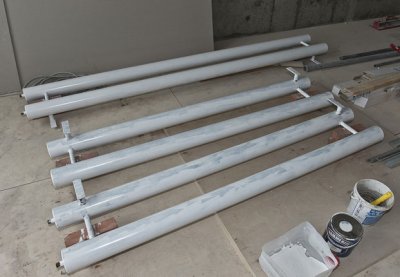
You won't be able to make a radiator yourself, but a person who has the skills to work with a welding machine can assemble a register from smooth or profile pipes.
All you need to make it is pipe sections, two couplings and several electrodes.
Content
Purpose of heating registers
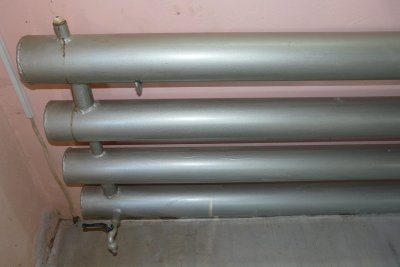
These devices are rarely used in everyday life. They are usually installed in production and storage facilities. This a cheap alternative to expensive radiators.
The distinctive feature of the devices is a large volume of coolant inside, which heats up quickly and cools down slowly. Hence high heat output.
They are installed in exactly the same way as regular radiators, according to the same diagrams, standards and rules.
Design features
Essentially, the register is one or more pipes, connected to each other parallel. It is important to create conditions for the heat carrier to flow consistently from one pipe to another, giving off heat to the room. Therefore, two types of registers are manufactured.
Sectional
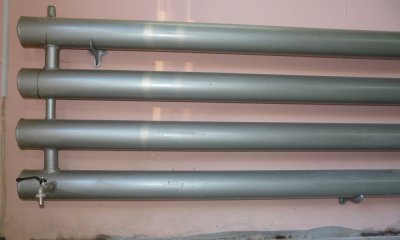
Several parallel pipes with closed ends with plugs. Jumpers are installed between them, through which the coolant flows from one section to another. It moves from top to bottom, that is, it enters the upper pipe and exits from the lower one.
Important! The jumpers are installed in a staggered pattern. If between the first and second sections the jumper is installed on the left, then between the second and third - on the right.
The diameter of the jumpers is much smaller than the diameter of the sections. For example, if the diameter of the main element of the register 80 mm, then jumpers 32—40 mm.
Serpentine, their drawing
This is the same design, only the sections are connected to each other. connect with double 90° bends the same diameter as the main pipes and a continuous pipe structure of one large diameter along the entire length is obtained. The heat transfer of this type of register is much higher than that of the previous version.
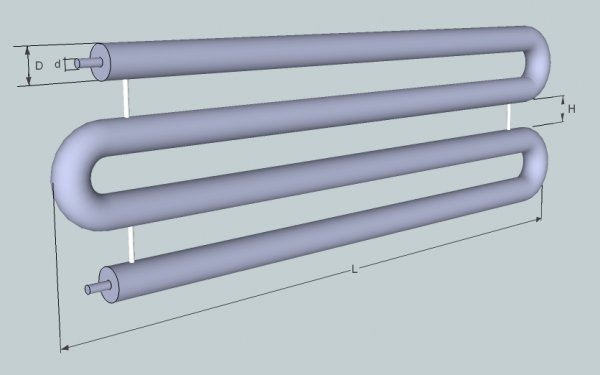
Photo 1. Drawing of a coil-type register, which is a solid tubular structure of one diameter along its entire length.
The advantages of the design include: low hydraulic pressure coolant inside the device, which allows a fairly large volume of hot water to pass through it.
Reference! The coil can be installed either horizontally, or vertically.
Advantages of registers
You need to compare registers with radiators heating systems, which they compete with.
Advantages:
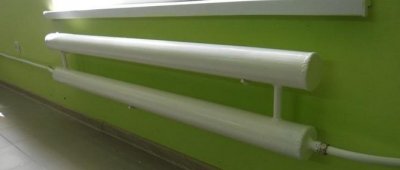
- they hold up well pressure drops coolant and its temperature;
- can be made with your own hands;
- low cost device;
- possibility to assemble the device different sizes both in length and height;
- heat is distributed throughout all sections evenly;
- simplicity maintenance and repair.
Flaws:
- Registers do not have a presentable appearanceYou can camouflage them by installing a decorative screen.
- Heating efficiency registers below, than standard radiators.
Welding technology
Purely technologically, the connection of steel elements is made either by electric or gas welding, where the technology is practically the same. When welding registers, note that in serpentine structures, joints are vertical seams, and in sectional both vertical and horizontalIt is easier to cook the latter, because they are located on the table plane.
On the technology of welding horizontal seams (section + jumper) The following requirements are imposed:
- The tack weld can be carried out at one or two points, placing the jumper vertically. Two points are located symmetrically relative to the axis of the jumper installation.
- A joint connected by one point of a tack welds immediately, but the process must be started from the opposite side of the potholder.
- The joint, connected by two tack welds, is welded from the first point.
- Vertical seams in registers - connection of main pipes with plugs and bends 90°. The following requirements apply to seams of this type:
- If the thickness of the pipe up to 3 mm, then the joint is welded in one go electrode 2.5 mm.
- If the thickness exceeds 4 mm, then welding is carried out in two passes: with a root seam, and on top with a facing roller.
- When connecting pipes with a diameter more than 60 mm welding is performed in sections along the entire perimeter of the joint.
There are general welding rules that designate purely technological methods. For example, the end of the seam must be welded to the beginning, forming a "castle". If welding is performed with two seams, then the second one is carried out in the opposite direction of the first one.
There are several welding parameters that you need to pay attention to when carrying out welding work. These are electrode diameter, which is selected depending on the thickness of the steel workpieces being welded, this is the current strength supplied to the electrode from the welding machine, the polarity and voltage of the welding arc.

Ratio of metal thickness to electrode diameter
| Metal thickness, mm | 1-2 | 3-5 | 4-10 | 12—24 | 30-60 |
| Electrode diameter, mm | 2-3 | 3-4 | 4-5 | 5-6 | 6 and more |
The current strength is selected depending on the diameter of the selected electrode. The relationship is as follows: I=Kd, Where TO — coefficient of correlation with the electrode diameter.
| Electrode diameter, mm | >2 | 3 | 4 | 5 | 6 |
| Coefficient - "K" | 25-30 | 30-35 | 35-40 | 40-45 | 50-60 |
How to make a homemade register from profile, smooth steel pipes
Welding work, which is the basis for the production of registers for the heating system, requires the presence of a certain number of different tools and materials.
Tools and materials for DIY
Except welding machine, you will need the following tools:
- for cutting: grinder, plasma cutter or gas torch (cutter);
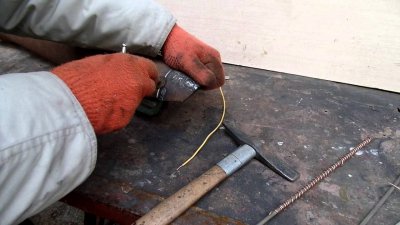
- tape measure and pencil;
- hammer and gas wrench;
- building level;
Materials for welding:
- electrodes, if electric welding is used;
- wire, if gas;
- oxygen and acetylene in cylinders.
Work order: how to weld a structure?
Depending on the selected type of construction (sectional or coil), the assembly of the registers will differ dramatically. The most difficult ones are sectional ones, because they contain the most joints of elements of different sizes.
Before proceeding to the assembly of the register, it is necessary to make a drawing, understand the dimensions and quantity. They depend on the heat transfer of the pipe. For example, 1 m of pipe with a diameter of 60 mm or a cross-section of 60x60 mm and a thickness of 3 mm intended for heating 1 m² of area heated premises, taking into account that the height of the ceilings does not exceed 3 m.
The first thing you need to do is cut from the selected pipe segments in accordance with the calculated length of the sections. The ends must be ground and cleaned from scale and burr.
Before assembling sectional devices, you need to apply markings on them, along which the jumpers will be installed. Usually it is 10-20 cm from the edges sectional pipes. A mark is made on the upper element where the coupling for the air vent will be installed (Mayevsky crane). It is located on the opposite side and along the edge of the section and along the outer plane.
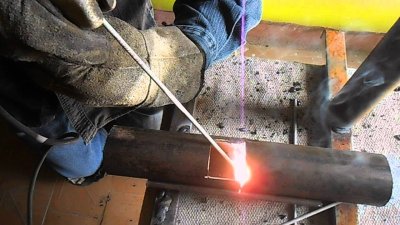
- Using a gas torch or plasma cutter, marks are made in the pipes holes taking into account that the jumper pipe could enter them.
- The jumpers themselves are cut from pipes of smaller diameter 30-50 cm.
- They are cut out of a metal profile segments the same length as the pipe jumpers. They will be installed as supports under the section pipes on the opposite side from the installation of the abutment element.
- Cut from sheet metal thickness 3-4 mm plugs according to the shape of the main pipe (circle or rectangle). two of them holes are made for the couplings, to which the supply and return circuits of the heating system will be connected through shut-off valves.
- First of all to the sections plugs are welded.
- The latter are welded squeezing.
- In production welding of jumpers with pipe sections.
- They are immediately attached by welding and supporting elements from cut steel profiles.
- It is welded pipe branch for installation of the Mayevsky crane.
- All seams are cleaned with a grinder and a grinding disc.
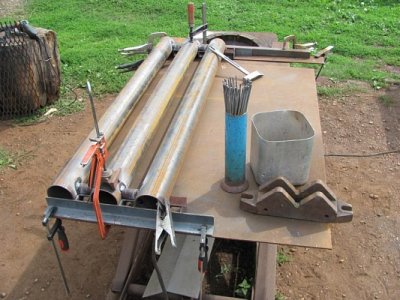
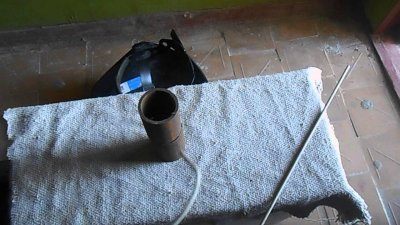
The assembly and welding process is best carried out on a flat surface, on which they are laid two or three wooden blocks (they can be replaced with steel profiles: angle or channel). It is on the bars that the pipe sections are laid out parallel to each other, taking into account the distance between the sections. As soon as the structure is assembled with tacks, you can begin welding all the seams, rotating the device so that welding is performed only in the horizontal plane.
As for the installation of registers. Depending on the plane to which they will be attached, it is necessary to think through and fasteners. There are several commonly used options.
If the device is to rest on a floor base, then under it install the legs. If it is going to be attached to the wall, then use regular ones. brackets with curved hooks up.
After the register is fully assembled, it must be checked for Seam tightness. To do this, one of the couplings is closed with a threaded plug, and water is poured through the second. The welds are checked. If a leak is detected, the defective area is welded again and cleaned. After all the operations have been carried out, the device is painted.
Manufacturing of serpentine register much easier. Firstly, bends are ready-made factory parts that are selected by diameter of pipe sectionSecondly, they are welded together in the same way as with the pipe.
First they connect two branches between each other. The resulting C-shaped fitting is connected in series with the ends of two pipes, combining them into a single structure. IN two free ends registers are installed plugs, in which holes are pre-drilled and the couplings are welded.
Useful video
Check out the video that shows how to weld a heating register with your own hands.
Calculation of quantity
Registers are devices in which the data moves. significant volume of coolant, because they are made from pipes large diameter, plus it includes several sections. To heat such a large volume of water, you will need a powerful heating boiler. And this is not only a considerable fuel consumption, but also considerable dimensions of the heating equipment itself.
Therefore, the heating system, which includes registers, must be calculated precisely taking into account heat consumed by the premises.
There are already ready-made tabular values of the ratio of the sizes of steel pipes and their heat transfer. This simplifies the calculation of the number of devices.
You can also calculate heat transfer using the formula: Q =π dlk (Tr - To), where:
- d — pipe diameter;
- l is its length;
- k is the heat transfer equal to 11.63 W/m²;
- Tr — room temperature;
- To — coolant temperature.
It is based on the calculations made that they select the length of the register, the number of sections in it and the number of devices themselves.